Guide 01 · Heating & hot water
Six checks before you ring a plumber.
Half the heating faults in an average house are things a reasonably confident householder can diagnose in an afternoon, and several are things you can put right without paying anybody. Here is the order to do them in — and the point at which it stops being a job for you.
Step by step
Six things, in this order.
Feel every radiator, top and bottom
Run the heating for half an hour and put a hand at the top and the bottom of each panel. Hot at the bottom and cold at the top is air, and bleeding fixes it. Hot at the top and cold at the bottom is the opposite problem — sludge lying in the bottom of the panel — and bleeding will do nothing at all. Knowing which one you have before you ring anybody saves a wasted visit.
Bleed, then check the pressure
Bleeding a radiator lets water out, so the system pressure drops. On a sealed system the gauge should sit around 1 to 1.5 bar when cold — top it back up with the filling loop until it does. If you find yourself topping up every few weeks, stop and ring someone: the water is going somewhere, and a system that is constantly refilled with fresh oxygenated water corrodes from the inside.
Balance the system
Balancing is the unglamorous art of making the far end of the house as warm as the near end. Every radiator has a lockshield valve under a plastic cap at one end; throttling the ones nearest the pump forces flow onward to the ones that never quite get hot. It takes an hour with a thermometer and it is free. Plenty of houses have never had it done, which is why the back bedroom has been cold since 2014.
Look at what comes out
When you bleed or drain a radiator, look at the water. Clear is healthy. Grey or black means magnetite — corrosion debris circulating through the system, settling in radiator bottoms and eventually blocking heat exchangers and pump impellers. That is the point at which a chemical clean or a power flush stops being optional maintenance and starts being cheaper than the alternative.
Check the thermostatic valves actually move
A thermostatic radiator valve has a pin under the head that seizes if it has sat in one position for years. Pull the head off and press the pin: it should spring back. If it is stuck down the radiator stays hot whatever you set it to; stuck up and the radiator never warms. A seized TRV is one of the cheapest components in a house and one of the most common causes of a room that will not behave.
Give the hot water the same treatment
Hot water that is fine downstairs and feeble upstairs is usually pressure, not temperature — a gravity-fed system running out of head, which a pump or a change of arrangement fixes. Hot water that runs hot then lukewarm points at a cylinder coil, a thermostat or a scaled heat exchanger. In a hard-water area, scale is the quiet enemy: it shortens the life of every heated component in the house.
Warning signs
Six symptoms worth a phone call.
None of these mean disaster. All of them mean the system is telling you something, and all of them get more expensive the longer they are ignored.
The pressure keeps dropping
A sealed system that needs topping up every few weeks is losing water somewhere — a weeping joint, a radiator valve gland, or a failed expansion vessel. Topping it up forever is not a repair; it is a slow way of ruining the system.
Radiators cold at the bottom
Sludge, not air. Bleeding will not fix it. Depending on how far it has gone you need a chemical clean or a power flush, then a magnetic filter so the same debris does not quietly rebuild over the next five years.
Banging, knocking or kettling
Kettling — a noise like a kettle coming to the boil — usually means scale or debris where the water is heated. Knocking pipes under floors are often clips that have worked loose and expansion doing the rest. Neither is urgent; both get worse.
Hot water that runs lukewarm
Hot then tepid usually means a cylinder coil, a thermostat or a scaled plate heat exchanger, depending on the system. All are repairable. None of them fix themselves.
Weak flow upstairs
Almost always a pressure problem rather than a blockage — a tank too low, a pipe run too long, or a pump that has given up. A correctly specified pump or a mains upgrade is usually the answer, and it is worth diagnosing before anybody starts replacing taps.
Any smell of gas
Not a plumbing matter and not something to sit on. Open windows, do not operate any electrical switches, leave the building and ring the National Gas Emergency Service on 0800 111 999 straight away.
If you smell gas
Do not ring a plumber first. Open doors and windows, do not operate any electrical switches, turn the gas off at the meter if you can reach it safely, leave the building and ring the National Gas Emergency Service on 0800 111 999. They are free, they are available 24 hours, and their job is to make it safe.
Clean, flush or replace?
The honest version of a question with a vested answer.
Anyone quoting for a power flush has an interest in the answer, which is exactly why the reasoning should be laid out rather than asserted. The rough shape of it: if the water coming out is slightly discoloured and only one or two radiators are sluggish, a chemical clean left to circulate for a week or two will often do it. If the water is black, several radiators are cold across the bottom half, and the system has never been cleaned, that is what a power flush is actually for.
And if a single panel is corroded through or blocked solid, flushing the whole house to rescue one radiator is the expensive way round — replace the panel. What should never happen is new kit going onto a dirty system: it is how you buy a second problem, because the debris that killed the last component is still in there waiting.
Fitting a magnetic filter afterwards is not an upsell. It is the thing that stops the same sludge quietly rebuilding over the following five years, and it costs a fraction of doing the whole job twice.
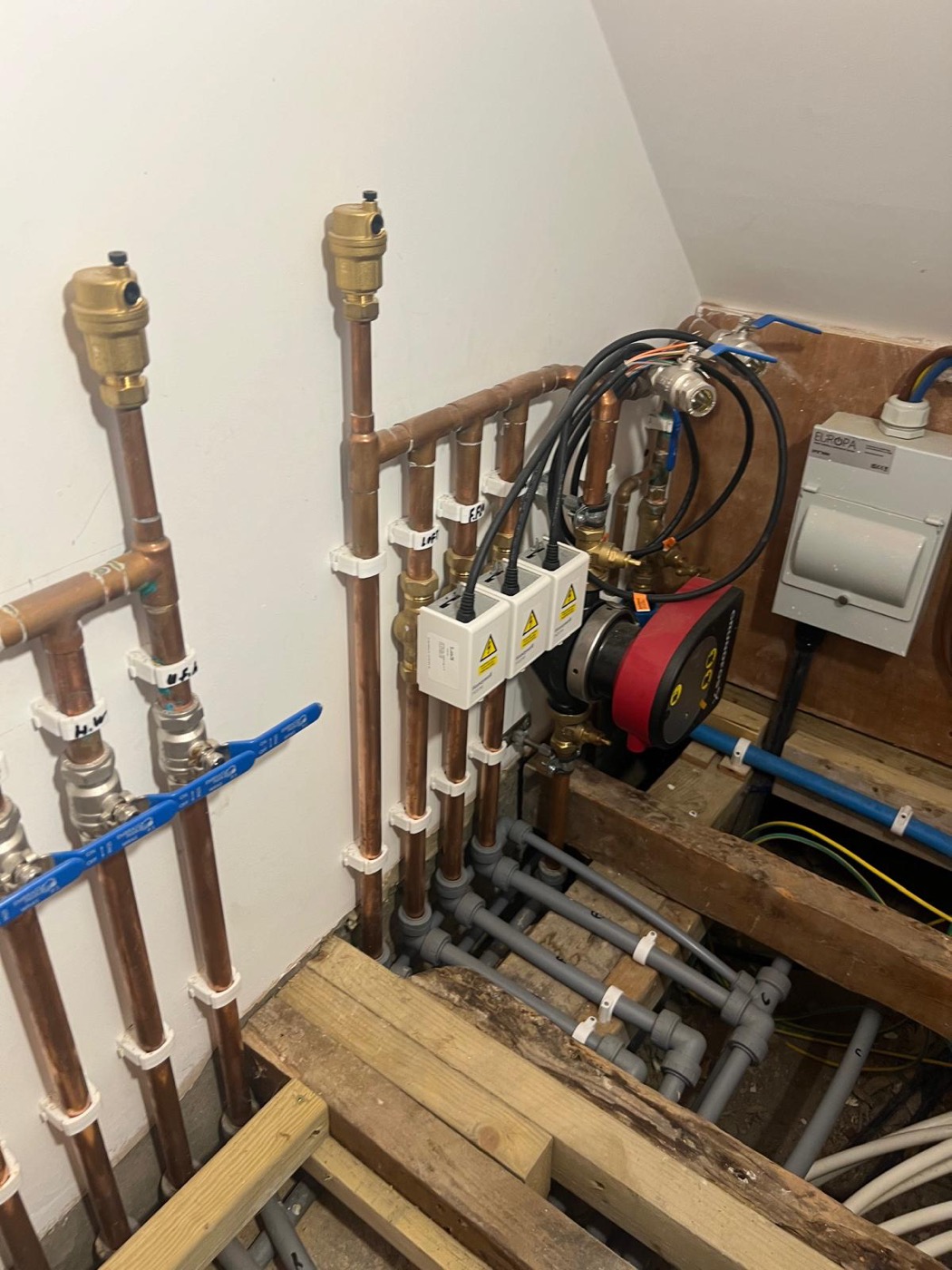
When Fahim Patel had a complete central heating system put into his house from scratch, the words he reached for were “professionally, promptly and at very short notice”. Ask for the same reasoning on your job, from whoever you use: what is wrong, what the options are, and which one you would choose if it were your own house.
Five questions worth asking any plumber
- 01Is this repairable, and what would the repair cost against replacing it?
- 02Does the system need cleaning before anything new goes on it — and why?
- 03If you are fitting a pump or a new radiator, why this size for this house?
- 04What have you found that is not urgent today but will need doing next?
- 05Are you insured for this work, and can I see the certificate?
Indrit would rather be asked all five. Anyone who bristles at any of them is telling you something useful.
Got past step three and stopped?
That is the right moment to ring. Call Indrit on 01582 291941, or send a photo of the radiator, the gauge or the cylinder to 07311 111602 on WhatsApp — he can tell you a great deal before he even sets off.